
Read the complete resource
A new domestic technology for long-term storage and transport of fruit and vegetables minimises quality losses.
Existing normal, controlled and modified atmosphere technologies (NA, CA and MA, respectively) do not guarantee protection from many physiological disorders (superficial scald, breakdown, soft scald and internal tissue browning) and fungal diseases, or preservation of initial quality (freshness, juiciness, firmness and nutritional value) during storage, transport and sale. Producers consequently suffer enormous losses of up to 30-50%, while consumers are not always satisfied with quality.
Our analysis of domestic and foreign literature and many years of our own research established that excessive ethylene accumulation inside fruit and in the environment is the main cause of disease and declining quality [1], [2]. Endogenous ethylene, synthesised by fruit, or exogenous ethylene from the environment activates ripening, overripening and ageing at extremely low concentrations, causing physiological and fungal diseases and resulting quality loss. The fundamental solution for long-term preservation of fruit and vegetable quality is to inhibit ethylene synthesis and prevent its negative effects.
The main storage disorder is superficial scald. More than 70% of varieties grown in Russia are susceptible. It causes enormous economic damage: according to data we have accumulated over many years, incidence can reach 90% or more.
The apple varieties most susceptible to superficial scald are Antonovka Obyknovennaya, Granny Smith, Red Delicious, Delicious, Martovskoye, Renet Simirenko, Jonagold, Starcrimson, Braebum, Corey, Severny Sinap, Sinap Orlovsky, Sinap Belorussky, Berkutovskoye, Kulikovskoye, Veteran, Vishnevoye, Imrus, Red Chief, Renet Chernenko, Renet Kursky Zolotoy, Kuybyshevskoye, Mutsu and others.
About 200 thousand tonnes of these varieties are stored annually in Russia. Average losses from this disorder are estimated at 5-8 thousand roubles/t, or 1-1.6 billion roubles for the total volume.
Higher ethylene also promotes premature ripening, ageing and loss of juiciness, firmness, flavour and nutritional value, sharply reducing quality during storage and transport.
At the very end of the 20th century, SmartFresh appeared in the USAsm. This name is a registered service mark for 1-methylcyclopropene synthesised by researchers at North Carolina State University and distributed by the American company AgroFresh Inc., founded in December 1999. Postharvest fruit treatment with SmartFreshsm slows postharvest ripening and ageing, significantly reduces losses and preserves produce quality. Storage technology using SmartFreshsm
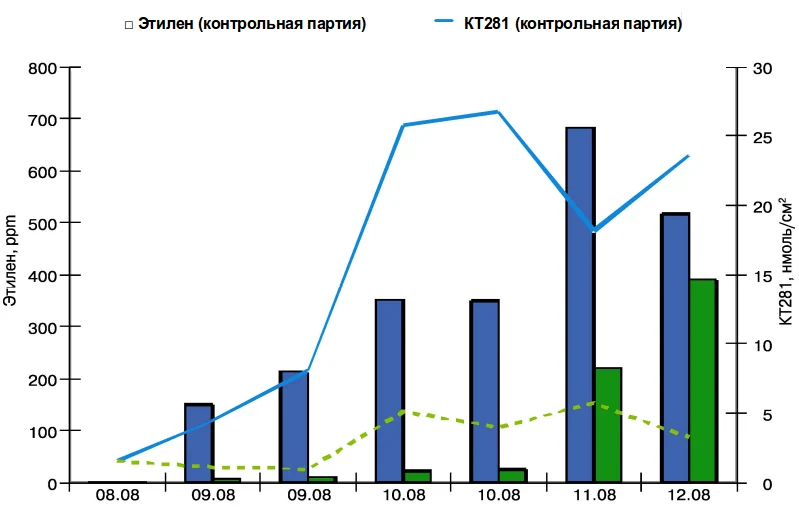
Fig. 1. Effects of Fitomag treatment on endogenous ethylene and conjugated triene content in the skin of Antonovka Obyknovennaya fruit
Vladimir Gudkovsky,
Doctor of Agricultural Sciences, Academician of the Russian Academy of Agricultural Sciences, Professor, Head of the Postharvest Technologies Department at the I.V. Michurin All-Russian Research Institute of Horticulture (Michurinsk, Tambov Region)
Valery Shvets,
Doctor of Technical Sciences, Professor, Head of the Department of Basic Organic and Petrochemical Synthesis Technology at the D.I. Mendeleev Russian University of Chemical Technology (Moscow)
Source: September 2009 #1 (1) RussiafruiT