
Read the complete resource
Ahead of the coming fruit harvest season, the 20th for Fitomag, we are launching a series of publications on different aspects of storage, packaging and transport of various fruit and vegetables.
We want to share our extensive experience in fruit and vegetable storage and describe the achievements, problems and tasks our team works on across the country and abroad, so that current and future clients can preserve quality as fully as possible and reduce produce losses.
As the storage season approaches and traditionally begins with plums, our first publication is devoted to this fruit. Most clients know us as a reliable, long-established partner in storing late apple varieties, but are less familiar with our achievements and research in plum storage. We have such experience, for example in Moldova. Practically since we began work in this region, we have paid considerable attention to plums alongside apples because plums rank third in fruit exports after apples and table grapes, at more than 70 thousand tonnes annually. More than half of this volume reaches export markets after 4-8 weeks of storage. So when someone enters the market boasting that their company is two years old and has major success in plum storage, we find it amusing, but for clients the consequences may be very unfortunate. A serious approach, such as Fitomag’s, requires many more years of persistent, focused work to achieve significant results in agribusiness. The final result is affected by many climatic, agronomic, postharvest and other factors. Without accounting for them, one cannot simply treat a fruit batch with 1-MCP and expect good results. Fitomag takes a responsible approach, guided by the medical principle “Do no harm”. Before offering a product or service, we therefore undertake substantial work in several stages.
Firstly, our staff and external consultants carry out in-depth documentary research. Technical requirements are then formulated, and laboratory trials begin. The next stage is industrial application in experimental mode, under real conditions, carefully monitoring all fruit quality parameters, storage regimes and other factors. Only after all these stages do we launch the product or service for widespread use, providing clients with a clear protocol for each fruit variety, precise parameters for harvest timing and storage conditions, and even possible storage problems.
This article presents a brief overview of our many years of plum storage experience, identifies the most important factors affecting storage and describes our current research on this fruit.
First, a brief background:
Plum (Latin Prúnus) is a plant genus in the rose family (Rosaceae). It includes about 400 species, distributed mainly in northern temperate regions of the world.
The three most widely cultivated species do not occur in the wild, only around settlements: European plum (Prunus Domestica) can be traced to the mountains of Eastern Europe and the Caucasus, while Chinese plum (or Japanese plum) and Prunus simonii originated in China.
Japanese plums have a longer storage life than most European varieties and are therefore the most common commercially sold fresh plums.
Plum is a stone fruit and, by its ripening pattern, a climacteric fruit, meaning that fruit produces ethylene during ripening and is sensitive to its effects. That is why Fitomag’s 1-MCP treatment is an effective tool for preserving fruit quality during storage.
TABLE No. 1 : Ethylene release by ripe stone fruit at different temperatures
|
Fruit |
0 C |
5 C |
10 C |
20 C |
|
Nectarine |
0,01 - 5 |
0,02 - 10 |
0,05 - 50 |
0,1 - 160 |
|
Peach |
0,01 - 5 |
0,02 - 10 |
0,05 - 40 |
0,1 - 140 |
|
Plum |
0,01 - 5 |
0,02 - 15 |
0,04 - 60 |
0,1 - 200 |
- The unit of ethylene synthesis is ml C2H4/kg*hour
- Left-hand figure – average value for fruit at optimum maturity
- Right-hand figure – average value for overripe fruit
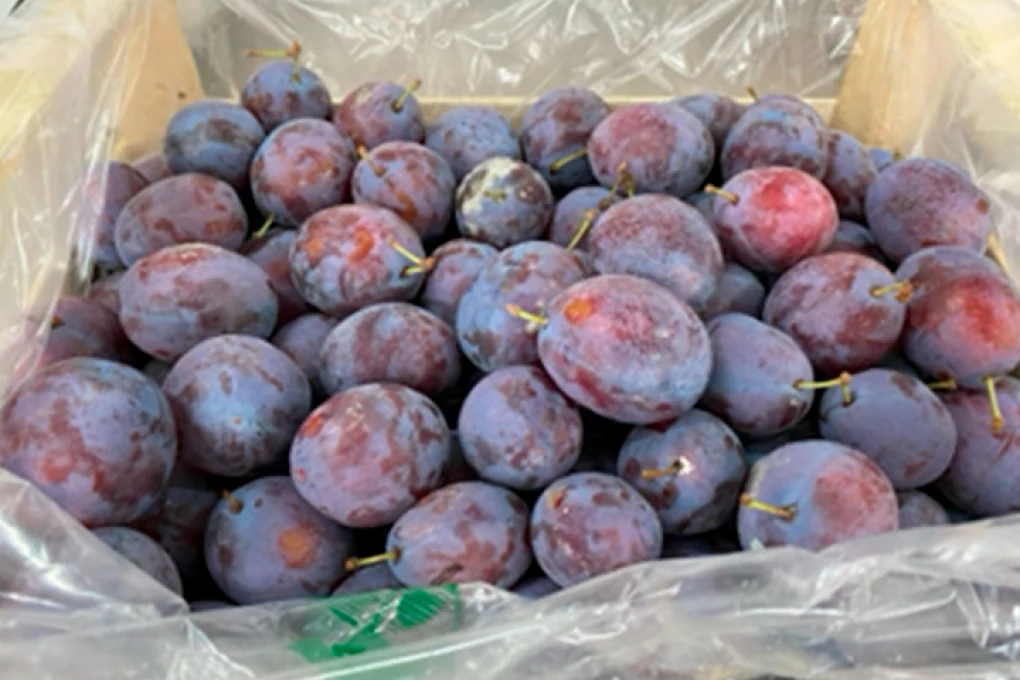
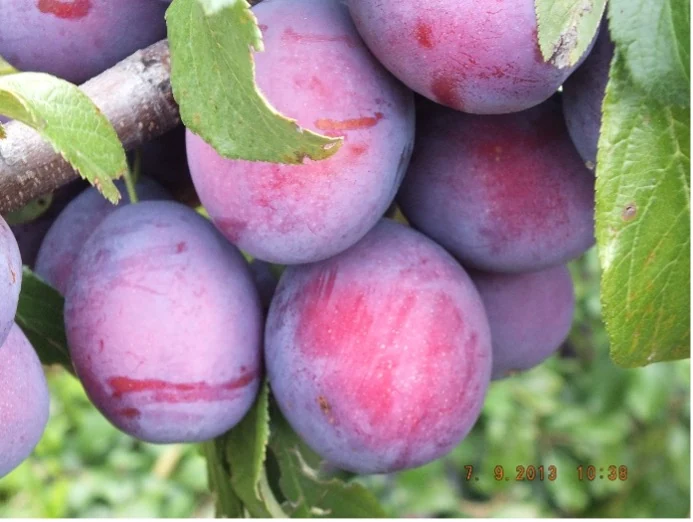
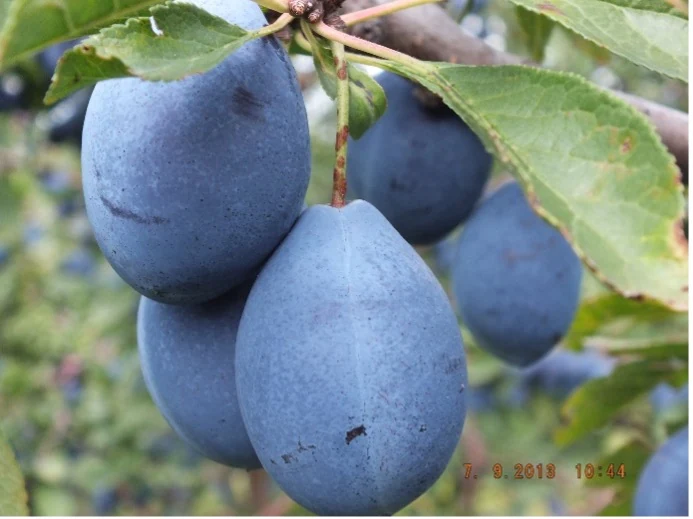
One of the most important factors for good storage results is harvesting at optimum maturity. We use the following methods to determine plum maturity:
- Appearance of fruit on the tree – size and skin colour. Assessing plum maturity by colour is fairly subjective and must rely on knowledge and experience of each specific variety.
 |
 |
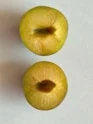
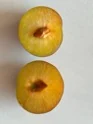
- Flesh colour – also a subjective but widely used method of determining plum maturity. There are fewer variations: green, green-yellow, yellow-green and yellow. For storage, we recommend picking plums when the flesh is green-yellow or yellow-green, conventionally the second and third stages.
 |
 |
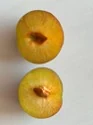 |
| PHOTO No. 3: Plums with different degrees of flesh coloration | ||
- Flesh firmness – an instrumental method, measured with a manual or digital penetrometer on a stand. In general, average firmness at harvest should be at least 3 kg/cm2 for most varieties; President and Angeleno usually have higher values. Measurement uses an 8 mm tip (the tip for apples has a diameter of 11 mm)
- Level of BRIX (sugar) and titratable acidity – another method we use, with the sugar-to-acidity ratio particularly informative.
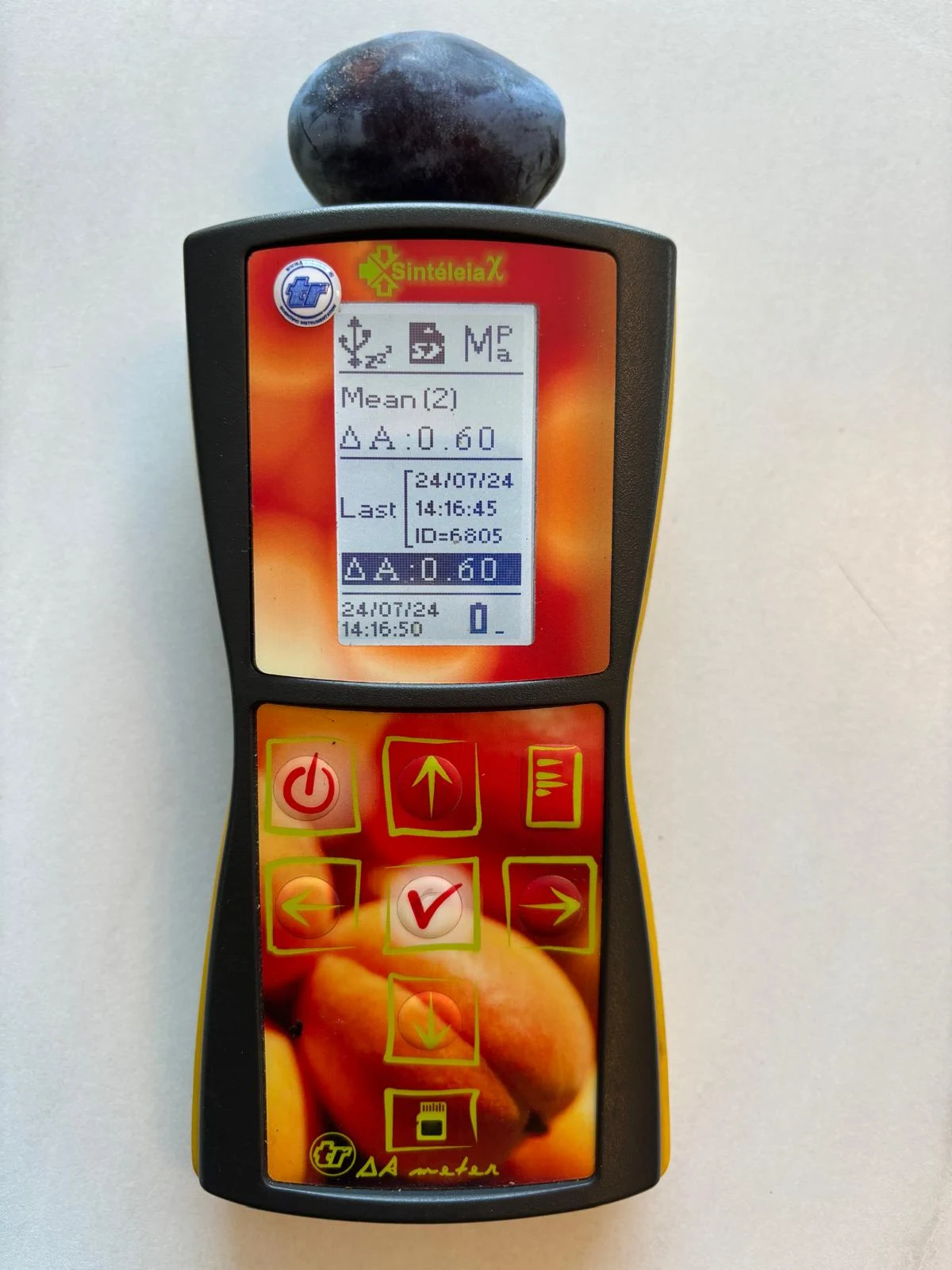
- A new non-destructive measurement methodbeing studied by our company is the use of DA-Meter. This instrument measures chlorophyll breakdown in fruit; the measurement result is the so-called DA-Index, whose value for plums ranges from 1.7 to 0.5 and below. The lower this index, the higher the maturity of the plums. This method is quite interesting and informative. We have used it for several years at every measurement stage, on the tree and in containers during storage, without damaging fruit.
 |
|
PHOTO No. 4: Measuring plum maturity with the instrument DA-Meter |
Another important factor is organising a high-quality, timely harvest.
Unlike other regions where plums are harvested like apples, first into bins and then sorted and packed on sorting lines, in Moldova they are picked directly into the packaging in which they will be stored and sent to consumers. This is generally a wooden tray measuring 500х300х150 mm with a capacity of 8-10 kg, although 400х300х150 mm trays of about 6 kg have become popular recently. Pickers sort fruit directly in the orchard. The most important task is selecting high-quality, healthy fruit of the required size, free from diseases, pests and mechanical damage, preferably retaining its wax bloom. Boxes of fruit are then placed on pallets directly in the orchard and sent for cooling.
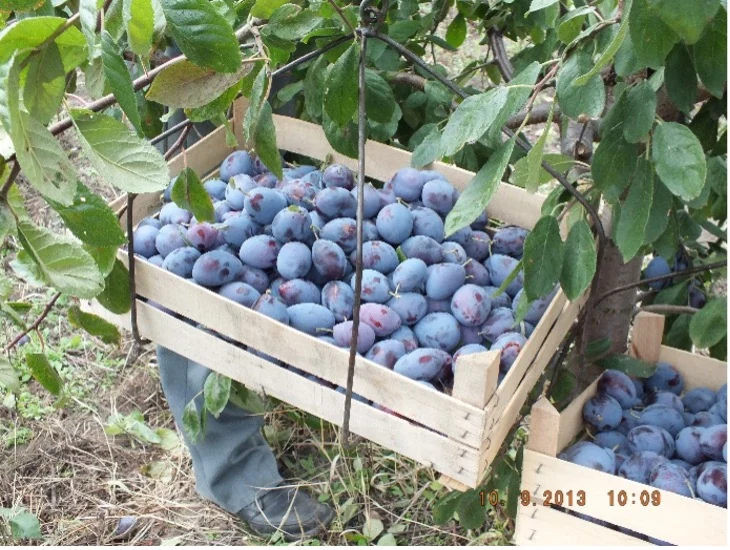 |
| PHOTO No. 5: Device for careful plum harvesting into a 9 kg wooden box |
As in controlled atmosphere storage, lower oxygen content reduces fruit respiration, significantly slowing ripening and ethylene synthesis. Higher carbon dioxide helps maintain firmness and inhibits pathogens. However, it also increases the risk of internal breakdown in some varieties, so researchers recommend extreme caution when using this method for plums. Our trials showed normal quality parameters for plums in MA bags for up to 40-50 days, but internal breakdown symptoms began appearing in many fruit after 50-60 days. An indisputable major benefit of storing plums in MA bags is a very low percentage of weight loss – in the range of 0.15-0.30%, compared with 3-5% in conventional storage. All Fitomag-treated variants performed better on every indicator than MA-bag storage without treatment.
These technologies have not gained widespread industrial use for several reasons. With controlled atmosphere storage, not everyone has small, compact rooms; batch uniformity is difficult to achieve; a long sales period after leaving the CA regime involves risks; and additional costs arise.
With MA bags, repacking is very labour-intensive, removes the wax bloom from fruit and increases internal breakdown risk; the bags are also costly. Since plums, unlike cherries, sell in a lower price segment, additional investment in these technologies is not always financially justified. Comparing the price-to-quality performance of different technologies, practice has shown:
Careful adherence to the Fitomag treatment protocol is the most suitable option for preserving quality with minimum effort and expense!
Main problems in plum storage
- Fungal diseases
Worldwide, and our region is no exception, the most aggressive pathogens are Botrytis cinerea and Monilinia fructicola, which cause fungal diseases in stone fruit. In most cases, infection takes place in the orchard, less often in containers, cold rooms or sorting lines. Timely fungicide treatments in the orchard are therefore essential for preventing these diseases during and after storage. Appropriate sanitation of premises and containers, gentle picking with minimal mechanical damage, excluding overripe fruit from packaging, and rapid fruit cooling – all these measures minimise disease losses.
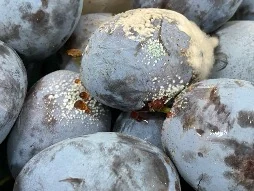 |
| PHOTO No. 6: Plums affected by fungal diseases. |
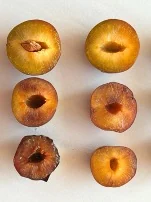
- Internal flesh breakdown
The main physiological disorder in many stone fruit, especially peaches, nectarines and plums, is internal flesh breakdown ( internal breakdown ). The main symptoms are soft, slimy, glassy or darkened flesh, spreading radially from the stone towards the outside of the fruit. Researchers worldwide interpret the causes differently, but most agree that, in plum varieties predisposed to this disorder, symptoms develop faster and more intensely at temperatures between +2°C and +7°Cthan at temperatures of 1°C – 0°C! Most farmers and exporters do not know this, so precise control of fruit temperature at every stage is essential to prevent the disorder.
 |
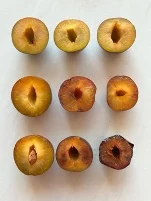 |
| PHOTO No. 7: Different degrees of internal flesh breakdown in plums | |
- Loss of flesh firmness
is also a plum storage problem because consumers prefer firm fruit. The speed and intensity of firmness decline during storage vary among varieties, but this indicator mainly depends on fruit temperature. The smallest firmness decline occurs during storage at -1°C – 0°C, whereas the greatest decline occurs at temperatures in the range +20°C - +25°C. Harvesting at optimum maturity must also be remembered: overripe fruit already has low firmness, so expecting high firmness after storage is pointless. We have observed that plum batches picked after prolonged high temperatures, especially from unirrigated orchards, have low initial firmness. Such fruit looks wilted and lacks juiciness, and we do not recommend storing those batches.
- Weight loss and fruit shrivelling
also depend on plum variety and harvest and storage factors. Picking at the optimum time, a short interval before cooling, rapid cooling and storage at optimum temperature and relative humidity preserve a fresh, attractive appearance, reduce weight loss and prevent shrivelling.
The above briefly summarises the plum storage experience and knowledge Fitomag has accumulated in its work on postharvest technologies. For clients, we have developed so-called treatment and storage protocols for each plum variety separately; currently these are the varieties Stanley, President and Angeleno. This season we are developing protocols for new varieties grown by farmers: Top Hit and others. When signing a treatment contract, all Fitomag clients receive a protocol and additional advice on any fruit storage questions, as well as support from our entire team throughout storage.
We are always pleased to help you earn from storing plums and other fruit and vegetables. Our company is your professional, experienced partner!
Alexander Kirtoka,
Postharvest Technology Specialist,
Master of Agricultural Sciences