
Read the complete resource
Many factors affect fruit susceptibility to superficial scald. The most significant are varietal genotype, harvest timing, treatment with an ethylene inhibitor (1-MCP), storage conditions and preharvest and postharvest stress factors.
In apple varieties susceptible to superficial scald, a direct relationship was found between the rate of accumulation of ethylene and α-farnesene oxidation products (CT281) and disease development. The shorter the period before the climacteric maximum of ethylene accumulation and the faster CT281 accumulation, the more susceptible the fruit is to scald.
Fitomag treatment effectively slows ethylene biosynthesis, CT281 and disease development, especially under cooling conditions.
Experiment description
More than 70% of apple varieties grown in Russia are susceptible to superficial scald; losses can reach 90% or more, adversely affecting fruit storage. Disease development is associated with accumulation of α-farnesene oxidation products (CT281) and phenolic compounds in fruit and with endogenous and exogenous ethylene content.
Apple susceptibility to superficial scald is determined by varietal genotype and more than 20 preharvest and postharvest factors.
In 2003, researchers at the D.I. Mendeleev Russian University of Chemical Technology developed Fitomag, accounting for Russia’s natural and climatic conditions and the characteristics of locally grown varieties. It is based on 1-methylcyclopropene (1-MCP), previously synthesised in the USA for postharvest fruit treatment. The effectiveness of Fitomag treatment in normal atmosphere (NA) and controlled atmosphere (CA) apple storage was studied.
In 2010–2011, studies examined the physiological and biochemical processes in different apple varieties after harvest, the effects of physiological condition on postharvest Fitomag treatment effectiveness, and susceptibility to superficial scald. Fruit from 8 varieties with differing susceptibility was selected, with endogenous ethylene of 0.5–1 ppm: Antonovka Obyknovennaya, Lobo, Martovskoye, Berkutovskoye, Severny Sinap, Zhigulevskoye, Bogatyr and Sinap Orlovsky. Ethylene, CT281 and fruit firmness were measured at the I.V. Michurin All-Russian Research Institute of Horticulture in Michurinsk.
One portion of the apples was stored at room conditions at T=+20–22°C to accelerate ripening and ageing, and the other at low temperature, T=+2–4°C. To study the effect of maturity on keeping quality and Fitomag treatment effectiveness, Antonovka Obyknovennaya fruit was picked at 3 dates, 7 days apart. Endogenous ethylene at harvest was 0.03, 0.7 and 53.6 ppm, respectively. Apples were stored in NA at T=+3°C, and Fitomag treatment was applied 1, 3 and 5 days after harvest.
The studies showed that apples grown in central Russia (Antonovka Obyknovennaya, Martovskoye, Zhigulevskoye, Lobo, Sinap Orlovsky and Bogatyr) have higher respiration, ethylene release and accumulation rates than varieties grown in the south (Renet Simirenko, Granny Smith, Golden Delicious and others). This suggests that intense ripening reduces keeping quality and increases scald susceptibility in varieties grown in the central zone (Fig. 1).
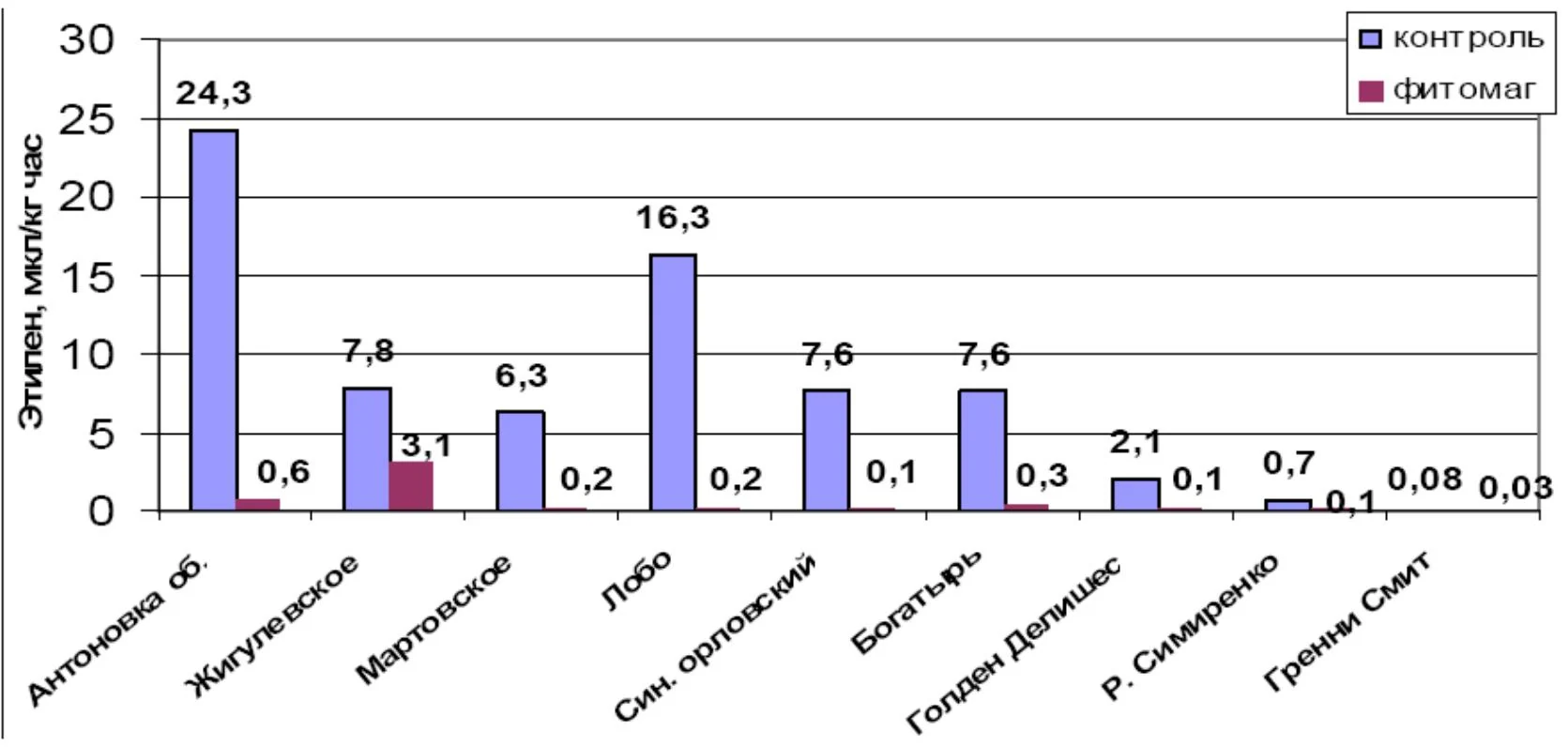
Fig. 1. Effects of varietal characteristics and Fitomag treatment on the rate of ethylene release by fruit (5 days after harvest, NA, T=+2–4°C)
At elevated temperature (T=+20–22°C), differences in the timing of the climacteric ethylene maximum in these varieties apparently determine their keeping quality and storage duration. The climacteric maximum occurred in Antonovka Obyknovennaya after 10 days, Zhigulevskoye after 30, Martovskoye, Sinap Orlovsky, Berkutovskoye and Severny Sinap after 40–42, and Bogatyr after 50 days at room conditions.
Varieties with low susceptibility to scald (Zhigulevskoye, Lobo and Severny Sinap) had the highest ethylene accumulation levels; varieties susceptible when ripening under constant warmth (Antonovka Obyknovennaya, Berkutovskoye, Martovskoye, Sinap Orlovsky and Bogatyr) had medium and low values.
CT281 accumulation rates and levels differ among varieties. Fruit of the highly susceptible Antonovka Obyknovennaya, Martovskoye and Berkutovskoye varieties accumulated CT281 faster than the others. The maximum CT281 accumulation in the studied varieties occurred close to or at the same time as maximum ethylene accumulation. This confirms the relationship between ethylene and CT281 accumulation in fruit.
The variety most susceptible to superficial scald is Antonovka Obyknovennaya, followed in descending order by Berkutovskoye, Martovskoye, Sinap Orlovsky, Severny Sinap, Bogatyr and Zhigulevskoye. In some years, Antonovka Obyknovennaya develops scald after 1–1.5 months in NA at T=+2°C; other varieties develop it much later or resist it. Fitomag treatment technology is therefore specific to each variety or variety group.
Fitomag treatment
Fitomag treatment slows accumulation of ethylene and CT281 and development of superficial scald. Even at high storage temperature (T=+20–22°C), treatment of Antonovka Obyknovennaya extends the period before the climacteric ethylene maximum by 3 weeks compared with the control and reduces the accumulation level (Fig. 2).
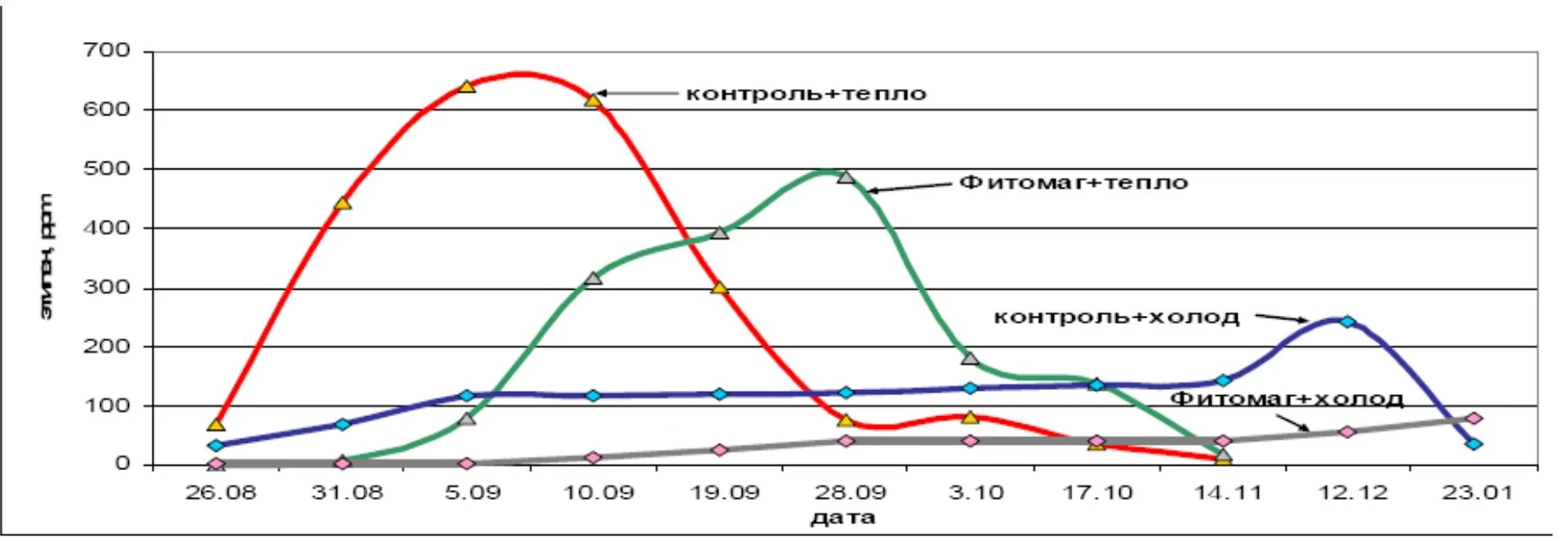
Fig. 2. Effects of Fitomag on endogenous ethylene dynamics in Antonovka Obyknovennaya fruit stored at high and low temperatures
Fitomag treatment is particularly effective when fruit is stored at low temperature (T=+2–4°C): the climacteric maximum in controls occurred after 3.5 months, while treated fruit showed none even after 5 months (Fig. 3). This is characteristic of all studied varieties.
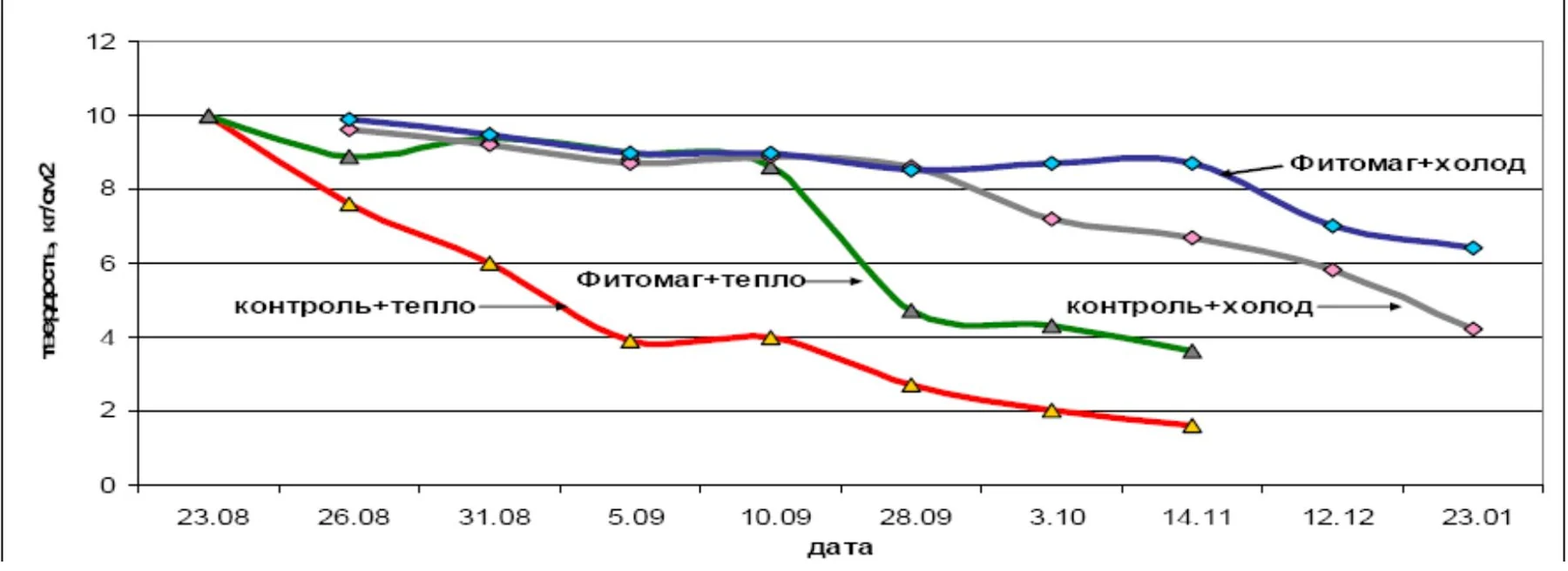
Fig. 3. Effects of Fitomag on flesh firmness decline in Antonovka Obyknovennaya fruit stored at high and low temperatures
Based on: Effects of varietal genotype, harvest timing, room loading and fruit treatment with an ethylene biosynthesis inhibitor on superficial scald development / Gudkovsky V.A. et al. // Michurinsk State Agrarian University Bulletin. 2012. No. 3. pp. 120–128.
Harvest timing
Harvest timing strongly affects fruit physiology, quality and keeping quality during storage.
In control and treated Antonovka Obyknovennaya batches picked at 3 dates, ethylene and CT281 accumulation dynamics and scald incidence differed greatly. The climacteric ethylene maximum occurred on 2 December for the 3rd harvest, 18 December for the 1st, and 14 January for the 2nd. In Fitomag-treated fruit from all dates, ethylene rose noticeably only after 5 months of storage, and levels were much lower than in controls; the highest values occurred in fruit from the 1st harvest.
The highest CT281 contents in control and treated fruit from the 1st and 2nd harvests were 38.6 and 26.5 nmol/cm2, respectively. Fruit from the 3rd harvest contained 10 nmol/cm2 at the end of January, 2.6–3.8 times lower.
In Fitomag-treated batches, regardless of harvest date, CT281 accumulation was much lower than in controls and increased only after 3 months. CT281 content was higher in fruit from the 1st harvest and lower in fruit from the 3rd. These relationships also apply to ethylene accumulation, confirming the link between ethylene biosynthesis and CT281.
Table 1. Physiological condition of Antonovka Obyknovennaya fruit after 4.5 months of NA storage
|
Harvest |
Scald losses, % |
Flesh firmness, |
||
|
in the control |
in the treated |
in the control |
in the treated |
|
|
1st |
89,4 |
6,6 |
4,8 |
5,4 |
|
2nd |
68,1 |
2,1 |
5,1 |
6,2 |
|
3rd |
16,5 |
0,1 |
4,2 |
4,6 |
Thus, maximum treatment effectiveness, with lower scald losses and high firmness, is achieved by harvesting at the optimum time, namely the 2nd harvest, when endogenous ethylene is 0.5–1 ppm. At this stage, Fitomag effectively blocks fruit receptors, slowing ethylene and CT281 accumulation, protecting against scald and preserving quality.
With early harvesting, insufficient antioxidant accumulation reduces Fitomag effectiveness and may lead to negative consequences for fruit, namely:
- insufficient ripening and bronzing (Golden Delicious);
- skin russeting on the uncoloured side, especially at sites affected by bitter pit (Sinap Orlovsky, Zhigulevskoye, Idared, Granny Smith and others);
- CO2 injury during CA storage.
With late harvesting, Fitomag treatment is less effective because most fruit receptors are already occupied by ethylene.
Timing of placement in storage
Room loading and postharvest Fitomag treatment timing also affect storage effectiveness.
If treatment is delayed, apples continue ripening in the room, accumulating ethylene and CT281 rapidly. Their characteristics resemble fruit that passed optimum maturity in the orchard.
Most central-zone varieties accumulate ethylene rapidly. To protect effectively against scald and retain high quality, room loading and postharvest Fitomag treatment must not exceed 1-2 days for Antonovka Obyknovennaya, 2-3 days for Martovskoye, and 3-4 days for Berkutovskoye, Sinap Orlovsky, Severny Sinap and Bogatyr.
Stress factors
Preharvest and postharvest stress factors also affect fruit susceptibility to superficial scald.
Early-picked fruit suffers more scald than fruit picked at optimum or later dates. Additional stress factors sometimes disrupt this pattern. One is oxidative stress, or photostress, caused by increased solar activity before harvest. Prolonged photostress intensifies free radical formation in fruit, sharply reducing defence functions and increasing scald susceptibility.
In 2011 at ZAO 15 let Oktyabrya, the scald-susceptible Sinap Belorussky variety showed the greatest damage in control and treated fruit from the 4th harvest (14–19 September), which experienced the highest preharvest solar activity.
When placed in cold rooms during cooling, fruit, regardless of harvest timing, experiences cold stress that intensifies free-radical oxidation in the skin cuticle.
The combination of increased preharvest solar activity and low postharvest temperatures has a cumulative negative effect on fruit placed in storage. This was confirmed by the mentioned Sinap Belorussky batch picked on 14–19 September. This apparently explains why Fitomag treatment of late-picked fruit was less productive, while earlier-picked fruit responded quite effectively.
Similar patterns were found for Berkutovskoye and Veteran.
Based on: Effects of varietal genotype, harvest timing, room loading and fruit treatment with an ethylene biosynthesis inhibitor on superficial scald development / Gudkovsky V.A. et al. // Michurinsk State Agrarian University Bulletin. 2012. No. 3. pp. 120–128.